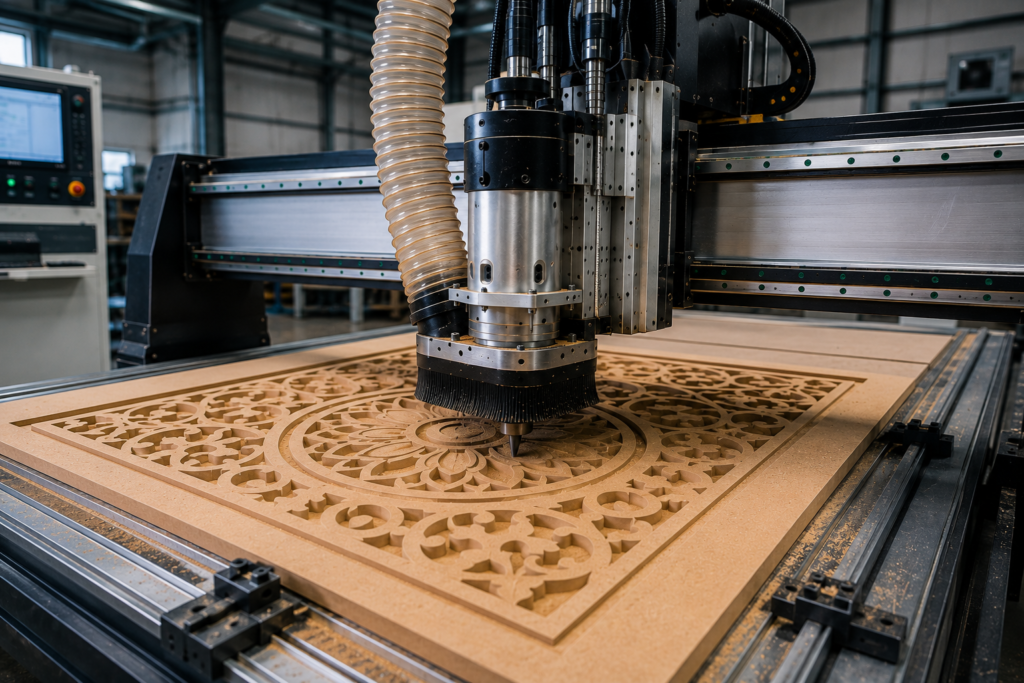
Precision is the foundation of quality manufacturing. Whether you’re producing custom furniture, architectural panels, acrylic displays, signage, or industrial components, every millimeter matters. Even a small deviation in dimensions can lead to poor assembly, material wastage, higher production costs, and dissatisfied customers.
This is where Precision CNC Cutting makes a significant difference. Unlike manual cutting methods that rely heavily on operator skill, CNC (Computer Numerical Control) machines use computer-programmed instructions to produce accurate, repeatable, and clean cuts with exceptional consistency. From intricate decorative patterns to large-scale industrial components, CNC technology enables manufacturers to achieve results that are difficult to replicate manually.
At Sourav CNC Works, precision is achieved through a combination of advanced CNC router machines, experienced operators, high-quality cutting tools, and strict quality control. Every project begins with careful planning, accurate digital designs, and the right machining strategy to ensure reliable outcomes.
In this guide, you’ll learn how CNC machines deliver high precision cutting, the factors that influence machining accuracy, the benefits for different industries, and what to look for when choosing a professional CNC cutting service.
What is Precision CNC Cutting?
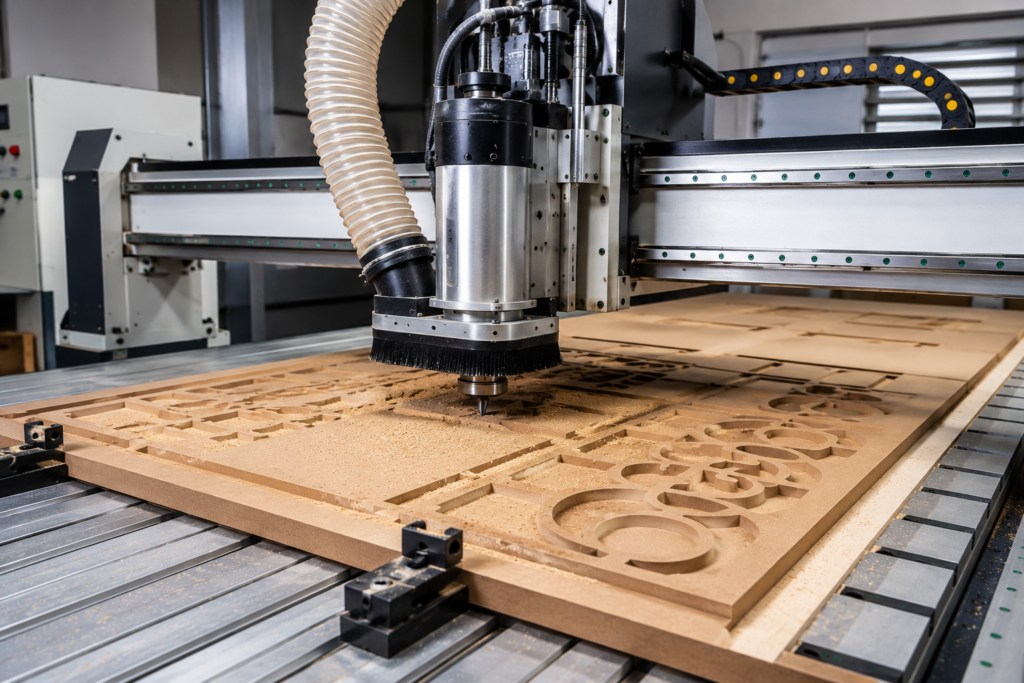
Precision CNC Cutting is a computer-controlled manufacturing process that cuts materials according to digital design files with exceptional accuracy and repeatability. The machine follows programmed toolpaths generated from CAD (Computer-Aided Design) software, ensuring every cut matches the intended dimensions.
Unlike traditional manual cutting methods, CNC technology minimizes human error and produces consistent results across single prototypes and large production runs.
Precision CNC cutting is widely used for:
- MDF furniture panels
- Acrylic display boards
- PVC sheets
- ACP cladding panels
- Wooden decorative panels
- CNC Jali designs
- Custom name plates
- 3D letter signage
- Interior décor elements
- Industrial machine components
Because the cutting process is automated, manufacturers can maintain uniform quality while reducing production time and material waste.
How CNC Router Machines Work
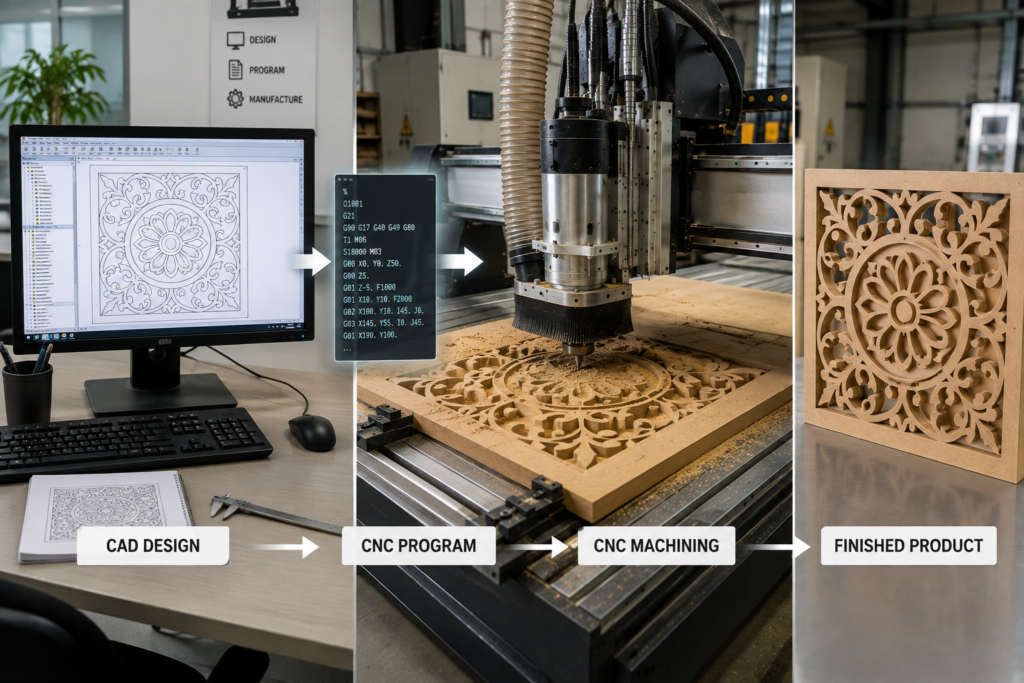
A CNC router machine transforms digital designs into physical products by following programmed instructions with remarkable accuracy. The process involves several stages, each contributing to the final precision.
1. CAD Design Preparation
Every project starts with a digital design created using CAD software. The design contains all measurements, curves, holes, and cutting paths required for the finished product.
Using digital files ensures that each part is produced exactly as designed, eliminating many of the measurement errors associated with manual fabrication.
2. CAM Programming
Once the design is complete, CAM (Computer-Aided Manufacturing) software converts the drawing into machine-readable instructions, commonly known as G-code.
This code controls:
- Tool movement
- Cutting speed
- Feed rate
- Spindle rotation
- Cutting depth
- Tool changes
Every movement of the CNC router is calculated before machining begins.
3. Material Setup
The workpiece is securely fixed onto the machine using vacuum tables or mechanical clamps.
Proper work holding is essential because even slight movement during machining can affect dimensional accuracy.
Experienced CNC operators inspect the material for:
- Flatness
- Thickness consistency
- Surface quality
- Warping
- Moisture (for wood materials)
4. Precision Machining
The CNC router follows the programmed toolpath while maintaining exact cutting depths and positions.
Modern CNC machines operate on multiple axes, allowing them to produce:
- Straight cuts
- Curves
- Intricate engravings
- Decorative patterns
- Complex geometries
- Repeated identical components
This level of control makes CNC technology suitable for both simple and highly detailed projects.
Why Precision Matters
Many industries depend on accurate machining because even minor dimensional errors can affect the final product.
High precision cutting helps businesses achieve:
Better Product Quality
Accurate dimensions improve assembly, appearance, and overall product performance.
Reduced Material Waste
Optimized nesting layouts maximize sheet utilization, reducing offcuts and lowering material costs.
Every part is manufactured according to the same digital design, ensuring consistency across production batches.
Faster Installation
Furniture components, signage, and decorative panels fit together correctly without additional adjustments.
Lower Manufacturing Costs
Consistent Production
Accurate machining reduces rework, minimizes rejected parts, and improves production efficiency.
Factors That Affect CNC Cutting Accuracy
Achieving precise results requires more than an advanced machine. Several technical factors work together to maintain accuracy.
Machine Calibration
Routine calibration ensures the machine moves precisely along the X, Y, and Z axes.
Professional workshops regularly inspect:
- Axis alignment
- Ball screws
- Linear guides
- Bearings
- Belt tension
- Spindle runout
Without proper calibration, dimensional errors can gradually increase over time.
Quality of Cutting Tools
Different materials require different cutting tools.
Using the correct tool improves:
- Edge finish
- Surface quality
- Dimensional accuracy
- Cutting speed
- Tool life
For example:
| Material | Recommended Tool |
|---|---|
| MDF | Compression Bit |
| Acrylic | Single Flute Bit |
| PVC | O-Flute Bit |
| ACP | Composite Cutter |
| Hardwood | Spiral End Mill |
Replacing worn tools before they lose efficiency helps maintain consistent quality.
Feed Rate and Spindle Speed
Incorrect machining parameters often result in:
- Burn marks
- Chipped edges
- Rough surfaces
- Excessive vibration
- Poor dimensional accuracy
Experienced CNC operators adjust cutting parameters according to:
- Material type
- Material thickness
- Tool diameter
- Required finish
- Machine capability
Material Quality
The quality of the raw material has a direct impact on machining accuracy.
Premium materials provide:
- Better dimensional stability
- Cleaner edges
- Reduced warping
- Improved finishing quality
Warped or low-density sheets can reduce machining precision even when using a high-quality CNC router.
Work Holding
A properly secured workpiece is essential.
Vacuum tables and precision clamping systems prevent movement during cutting, helping maintain accurate dimensions throughout the machining process.
Environmental Conditions
Temperature and humidity can affect certain materials, particularly wood-based products such as MDF and plywood.
Professional workshops store materials in suitable conditions before machining to reduce dimensional changes caused by moisture.
Precision Across Different Materials
One of the biggest advantages of CNC routing is its ability to machine a wide range of materials while maintaining consistent accuracy.
MDF Cutting
MDF is one of the most popular materials for CNC routing because of its uniform density and smooth surface.
Applications include:
- Modular furniture
- Decorative wall panels
- Cabinet doors
- CNC Jali
- Interior partitions
When proper cutting parameters are used, MDF produces smooth edges with minimal chipping.
Acrylic Cutting
Acrylic requires specialized tooling and optimized spindle speeds to avoid:
- Melting
- Cracking
- Edge whitening
Professional CNC machining creates clean, polished edges suitable for premium signage and display applications.
PVC Cutting
PVC machines cleanly when correct feed rates and sharp cutters are used.
Typical applications include:
- Sign boards
- Industrial panels
- Display systems
- Electrical components
ACP Cutting
Aluminum Composite Panels require dedicated cutting tools to maintain clean aluminum edges without damaging the core material.
ACP CNC cutting is commonly used for:
- Exterior signage
- Building facades
- Retail branding
- Commercial displays
Wood Cutting
Natural wood presents unique machining challenges because grain direction, density, and moisture content vary from one board to another.
Experienced CNC operators adjust machining strategies to produce smooth finishes while minimizing tear-out.
CNC Cutting vs Traditional Cutting
Choosing the right cutting method has a direct impact on product quality, production efficiency, and overall project costs. While manual cutting is suitable for simple tasks, CNC technology offers a higher level of accuracy, repeatability, and consistency.
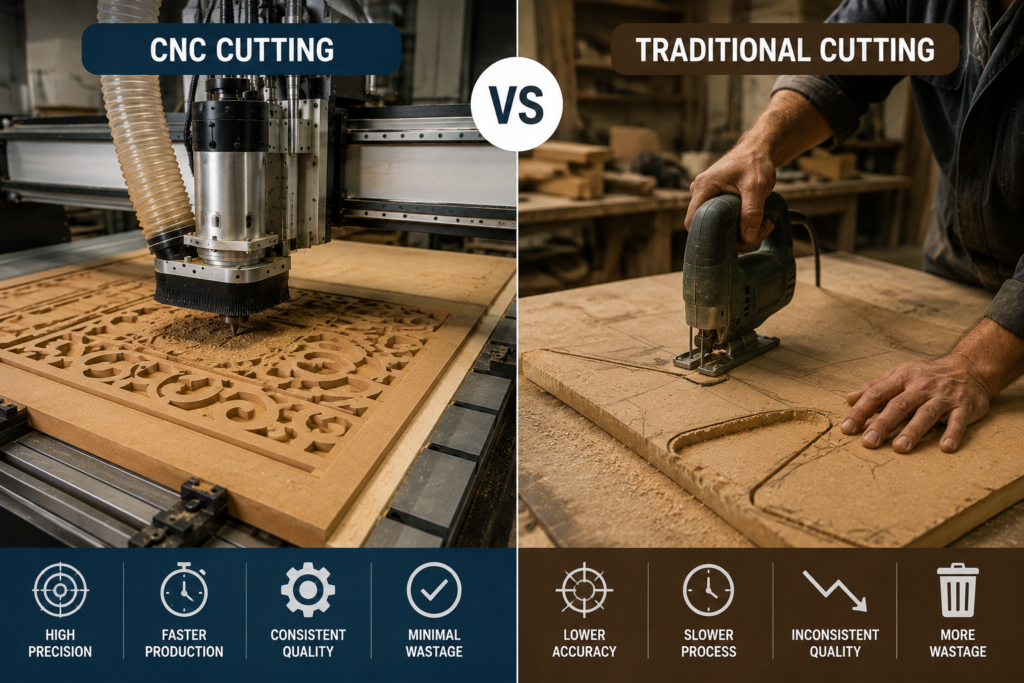
| Feature | CNC Router Machine | Traditional Cutting |
|---|---|---|
| Accuracy | Very High | Depends on operator skill |
| Repeatability | Excellent | Limited |
| Complex Designs | Easily achievable | Time-consuming and difficult |
| Production Speed | Fast | Slower |
| Material Waste | Low | Higher |
| Human Error | Minimal | Higher |
| Edge Quality | Smooth and consistent | May require additional finishing |
| Large Batch Production | Ideal | Less efficient |
For businesses handling regular production or detailed custom work, Precision CNC Cutting provides long-term advantages through consistent quality and reduced rework.
Benefits of Precision CNC Cutting Across Industries
Interior Design
Interior designers often require intricate decorative elements that fit perfectly during installation. CNC machining makes it possible to create elegant wall panels, partitions, ceilings, and furniture components with exceptional consistency.
Common applications include:
- Decorative wall panels
- CNC Jali designs
- Room dividers
- Ceiling panels
- Custom furniture parts
- Modular kitchen components
Furniture Manufacturing
Accurate dimensions are essential for furniture assembly. Poorly cut panels can cause alignment issues, visible gaps, and wasted materials.
Precision CNC Cutting helps furniture manufacturers by providing:
- Perfectly sized cabinet panels
- Accurate shelf components
- Clean edge profiles
- Consistent production for modular furniture
- Reduced assembly time
Signage and Advertising
The signage industry depends on clean edges and precise lettering to create a professional appearance.
CNC router machines are widely used for:
- Acrylic letters
- ACP signboards
- 3D logo signs
- LED signage
- Name plates
- Reception branding
Accurate cutting improves visual appeal and simplifies installation.
Manufacturing and Fabrication
Industrial manufacturers rely on CNC technology to produce repeatable components that meet design specifications.
Applications include:
- Machine panels
- Templates
- Production fixtures
- Equipment housings
- Control panels
- Industrial prototypes
Repeatable machining reduces production delays and ensures compatibility between components.
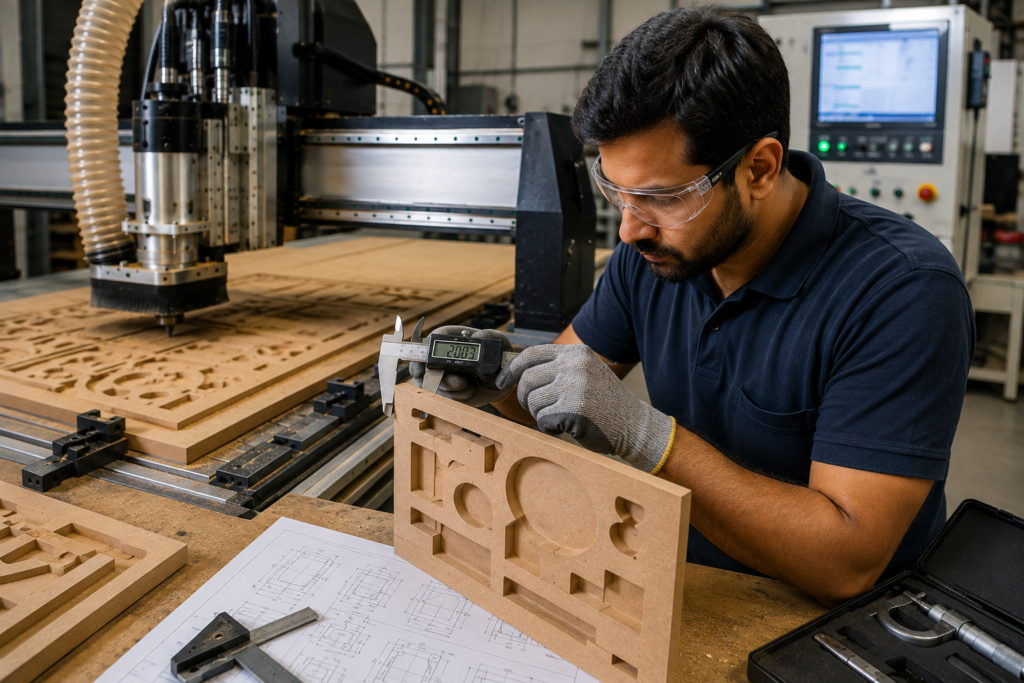
Quality Control Process
Producing accurate components requires more than advanced machinery. A structured quality control process helps identify issues before products reach the customer.
At Sourav CNC Works, every project is carefully checked throughout the machining process.
Material Inspection
Each sheet is inspected for:
- Thickness consistency
- Surface defects
- Warping
- Material quality
Design Verification
CAD files are reviewed to confirm:
- Dimensions
- Hole positions
- Engraving details
- Toolpath compatibility
Machine Setup
Before machining begins, operators verify:
- Tool condition
- Spindle alignment
- Machine calibration
- Material positioning
Final Inspection
Finished parts are checked for:
- Dimensional accuracy
- Edge quality
- Surface finish
- Overall appearance
- Design compliance
This systematic approach helps ensure reliable, high-quality results.
Common Mistakes Customers Should Avoid
Many machining issues can be prevented with proper planning.
Avoid these common mistakes:
Choosing Materials Based Only on Price
Lower-cost materials may have inconsistent density or poor dimensional stability, affecting the finished product.
Providing Low-Quality Design Files
Blurry images or inaccurate drawings can lead to production errors. Vector files or properly prepared CAD drawings are always preferred.
Ignoring Material Thickness
Different applications require different sheet thicknesses. Selecting the wrong thickness may reduce durability or affect installation.
Not Discussing Tolerances
Projects requiring tight tolerances should communicate dimensional requirements before machining begins.
Selecting Experience Over Price
Choosing a provider based only on the lowest quote can lead to poor edge quality, inaccurate dimensions, and additional costs for rework.
The cost of CNC cutting varies depending on several technical and production factors.
Cost Factors for Precision CNC Cutting
Material Type
Materials such as acrylic, ACP, MDF, hardwood, and PVC have different machining characteristics and costs.
Material Thickness
Thicker materials generally require longer machining times and specialized tooling.
Design Complexity
Simple straight cuts require less machine time than intricate decorative patterns or detailed engravings.
Quantity
Large production runs often reduce the cost per component because machine setup is completed only once.
Finishing Requirements
Additional services such as edge polishing, engraving, painting, or assembly increase project costs.
Custom Programming
Unique projects requiring CAD modifications or custom toolpath programming may involve additional preparation time.
Requesting detailed project specifications before production helps avoid unexpected costs.
Buying Guide: Choosing the Right CNC Cutting Service
Selecting the right CNC service provider can significantly affect project quality and delivery timelines.
Consider these factors before making a decision:
✔ Experience with multiple materials
✔ Modern CNC router machines
✔ Ability to work from CAD drawings
✔ Consistent quality control process
✔ Skilled machine operators
✔ Timely project delivery
✔ Custom design support
✔ Positive customer feedback
A reliable CNC partner should also provide practical recommendations on materials, machining methods, and finishing options rather than simply accepting the order.
Maintenance Tips for Long-Term Accuracy
Well-maintained CNC equipment consistently delivers better machining results.
Professional maintenance practices include:
- Cleaning machines after every production shift
- Lubricating moving components regularly
- Inspecting vacuum systems
- Checking spindle alignment
- Replacing worn cutting tools
- Calibrating machine axes
- Updating CNC software when appropriate
- Monitoring machine vibration
Routine maintenance improves machine life while maintaining consistent cutting precision.
Expert Tips from Industry Experience
Years of CNC machining have shown that attention to detail before production often determines the final quality.
Some practical recommendations include:
- Always review CAD drawings before machining.
- Match the cutting tool to the material.
- Use sharp cutters for cleaner edges.
- Test complex designs on sample material first.
- Store MDF and wood sheets in dry conditions to minimize warping.
- Plan efficient nesting layouts to reduce material waste.
- Confirm installation requirements before production begins.
These practices improve production efficiency and reduce costly mistakes.
Frequently Asked Questions
Precision CNC Cutting is a computer-controlled machining process that produces highly accurate and repeatable cuts based on digital design files.
What is Precision CNC Cutting?
How accurate is a CNC router machine?
The accuracy depends on machine quality, calibration, tooling, and material. Properly maintained industrial CNC routers can achieve very tight tolerances suitable for furniture, signage, and manufacturing applications.
Which materials can be cut using CNC routers?
CNC routers commonly cut:
- MDF
- Wood
- Plywood
- Acrylic
- PVC
- ACP
- Foam board
- Composite panels
Why is CNC cutting more accurate than manual cutting?
Because the machine follows digital instructions instead of manual measurements, reducing human error and ensuring consistent results.
Does CNC cutting reduce material waste?
Yes. Optimized nesting software and precise toolpaths improve sheet utilization and minimize waste.
Is CNC suitable for custom designs?
Yes. CNC technology is ideal for custom furniture, signage, decorative panels, prototypes, and one-off projects.
Can CNC machines produce identical parts repeatedly?
Yes. One of the biggest advantages of CNC machining is consistent repeatability across large production runs.
What industries benefit most from CNC cutting?
Industries including interior design, furniture manufacturing, architecture, advertising, signage, fabrication, and industrial manufacturing benefit from precision CNC machining.
How do I choose the right material for my project?
The ideal material depends on the application, durability requirements, appearance, budget, and installation environment. A professional CNC service provider can recommend the most suitable option.
Why choose Sourav CNC Works?
Sourav CNC Works provides precision CNC cutting for MDF, wood, acrylic, PVC, ACP, decorative panels, custom name plates, CNC Jali designs, and interior applications. Every project is handled with attention to design accuracy, quality control, and customer requirements.
Conclusion
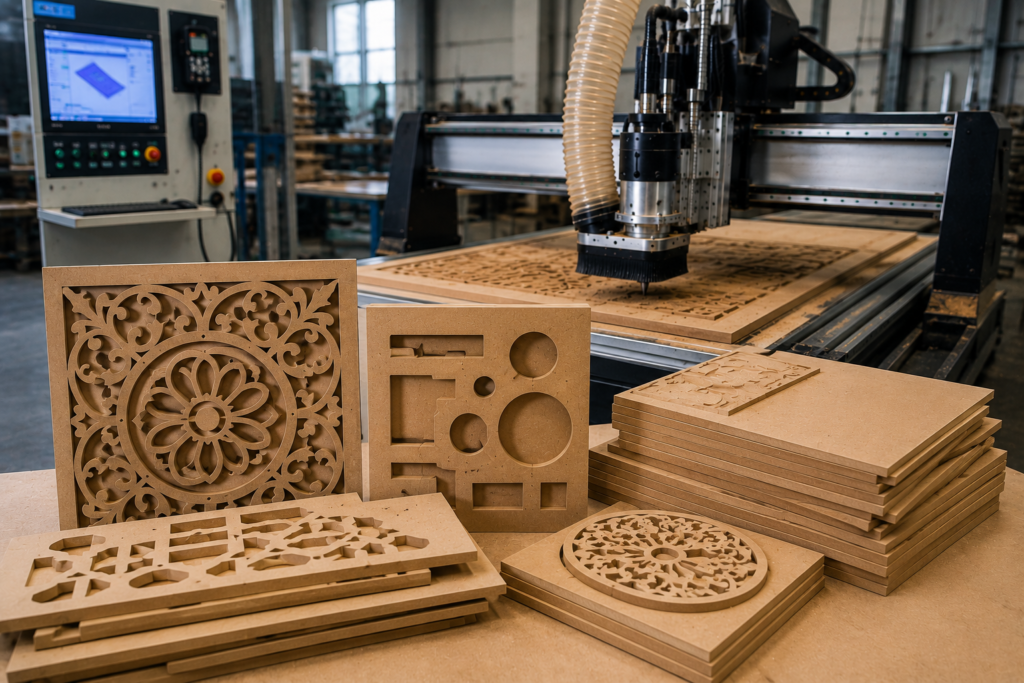
High-quality products begin with accurate manufacturing. Precision CNC cutting combines advanced machinery, digital design, skilled operators, and disciplined quality control to produce components that meet exact specifications.
From custom furniture and decorative panels to signage and industrial fabrication, CNC router machines offer the consistency, efficiency, and flexibility required by modern businesses. Choosing the right material, using proper tooling, and working with an experienced CNC service provider can significantly improve both product quality and production efficiency.
At Sourav CNC Works, every project is approached with a focus on accuracy, material expertise, and dependable craftsmanship. Whether you need intricate CNC Jali designs, MDF cutting, acrylic fabrication, ACP routing, or custom interior components, the team is committed to delivering reliable results that meet your project requirements.