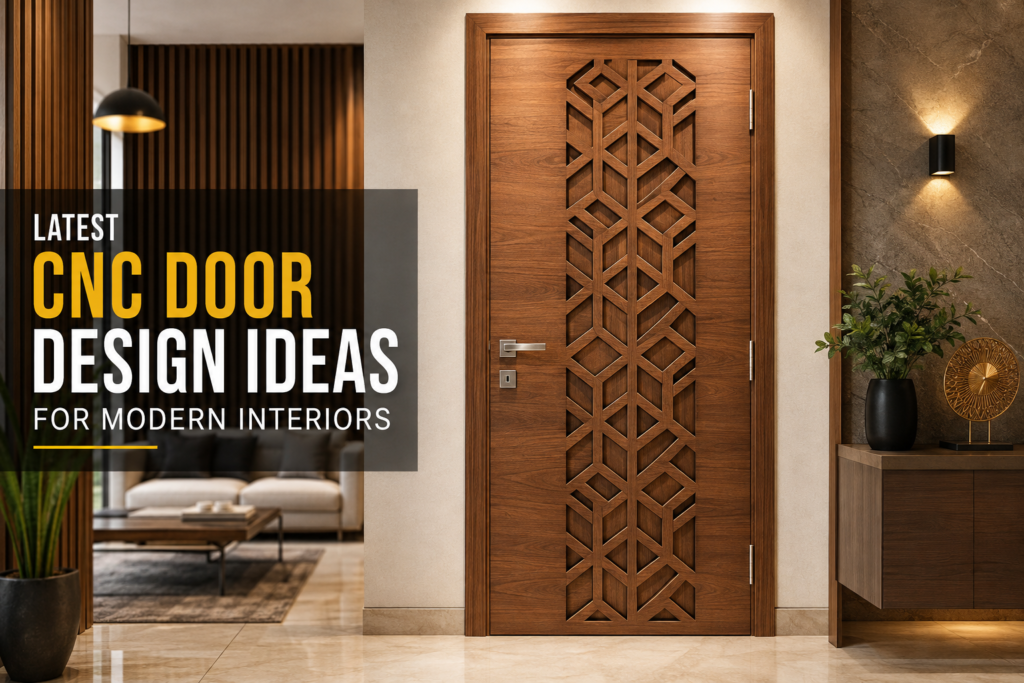
A door is more than an entry point. In a modern interior, it can become one of the most visible design elements in a room.
That is why CNC door design has become a popular choice for homeowners, interior designers, architects, and furniture professionals who want detailed patterns with clean and repeatable cutting.
Unlike manually carved patterns, CNC cutting uses a digital design file to guide the cutting tool. This makes it possible to create geometric patterns, floral motifs, jali-style designs, borders, grooves, and customized decorative elements with consistent detailing.
For wooden doors, the choice of material, thickness, pattern depth, cutter selection, finishing method, and final installation all influence the result. A good-looking design on a screen does not automatically make a good physical door. The pattern needs to be practical for the selected material and suitable for the door’s location.
This guide covers some of the latest CNC door design ideas, how CNC door cutting works, which materials are suitable, how to select a pattern, common mistakes to avoid, and what to check before placing an order.
What Is CNC Door Design?
CNC door design refers to a decorative or functional door pattern prepared digitally and produced using a computer-controlled CNC router.
The design can include:
- Geometric patterns
- Floral motifs
- Traditional Indian patterns
- CNC jali designs
- Abstract lines
- Circular and curved patterns
- Modern minimal grooves
- Custom logos or motifs
- Repeated decorative panels
- Combination patterns
The major advantage is control over the cutting process. Once the design has been prepared correctly, the CNC machine follows the programmed toolpath to produce the required pattern.
For a wooden door design, this can create a more consistent appearance across multiple panels or multiple doors.
The quality, however, depends on more than the machine. Material selection, design preparation, tool condition, cutting parameters, workholding, and finishing all matter.
Why CNC Door Designs Work Well in Modern Interiors
Modern interiors often use clean lines, controlled patterns, and coordinated finishes. CNC cutting fits naturally into this style because the design can be customized according to the size and character of the door.
1. Detailed Patterns
CNC routing can create intricate decorative patterns that would be difficult to reproduce consistently by hand.
2. Customization
A customer does not necessarily have to select a standard catalogue pattern. A design can be modified according to the required size, proportions, and visual style.
3. Consistent Cutting
For repeated designs, CNC machining can maintain consistent dimensions when the digital file and manufacturing setup are properly prepared.
4. Modern Appearance
Geometric grooves, abstract patterns, and symmetrical jali designs can give a traditional wooden door a contemporary appearance.
5. Suitable for Different Interior Styles
Depending on the pattern and finish, CNC doors can work with:
- Minimalist interiors
- Contemporary homes
- Traditional interiors
- Luxury-style spaces
- Office interiors
- Restaurant interiors
- Hotel interiors
- Pooja rooms
- Partition areas
Latest CNC Door Design Ideas for Modern Interiors
The best design is not always the most complicated one. In many modern projects, a controlled pattern with good spacing looks better than an extremely dense design.
Here are some practical CNC door design ideas.
1. Geometric CNC Door Design
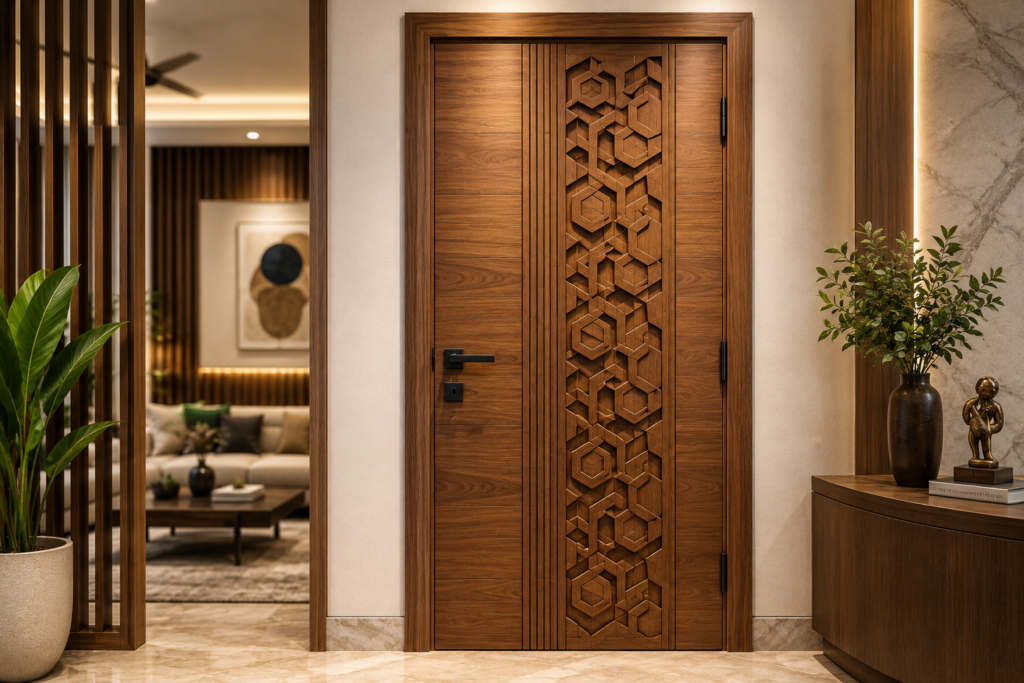
Geometric patterns are among the most versatile choices for modern interiors.
Squares, rectangles, diamonds, circles, hexagonal arrangements, and intersecting lines can create a structured appearance without making the door look excessively decorative.
This style works particularly well when the room already contains modern furniture and straight architectural lines.
Best for: Main doors, bedroom doors, office doors, and contemporary interiors.
2. CNC Jali Door Design
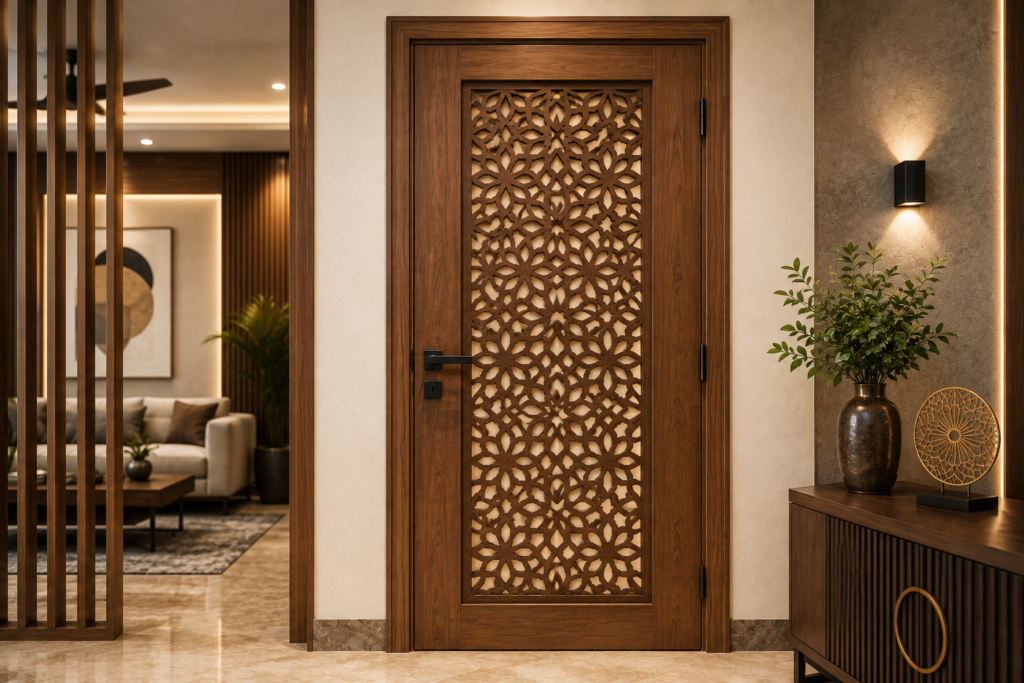
A CNC jali pattern can provide a decorative screen-like appearance while allowing controlled visual separation.
Jali patterns can be created with:
- Floral motifs
- Geometric shapes
- Traditional patterns
- Repeating symmetrical designs
- Contemporary abstract patterns
The important point is structural strength. Very thin bridges between cut areas can weaken a panel, especially when the door is large or frequently used.
For this reason, the pattern should be designed according to the material and intended application rather than simply copied from an image.
3. Minimal Groove CNC Door
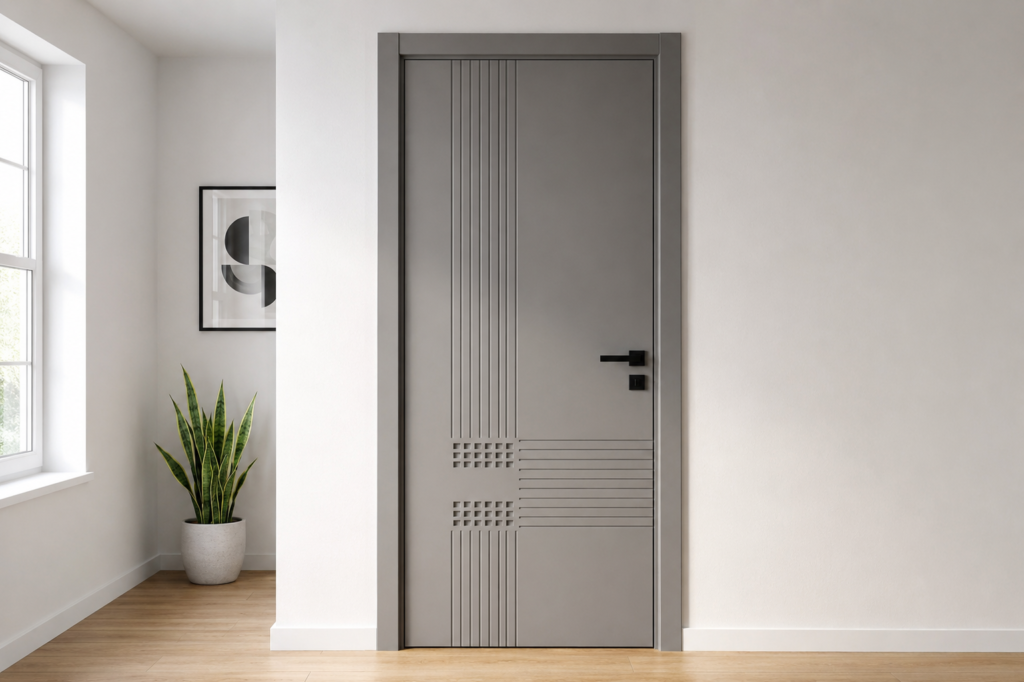
Not every CNC door needs deep or complicated carving.
A minimalist door can use shallow grooves, parallel lines, rectangular borders, or carefully positioned curves.
This approach is particularly suitable for interiors where the door should complement the furniture instead of becoming the dominant visual element.
Best for: Modern bedrooms, offices, wardrobes, and premium interior projects.
4. Floral CNC Wooden Door Design
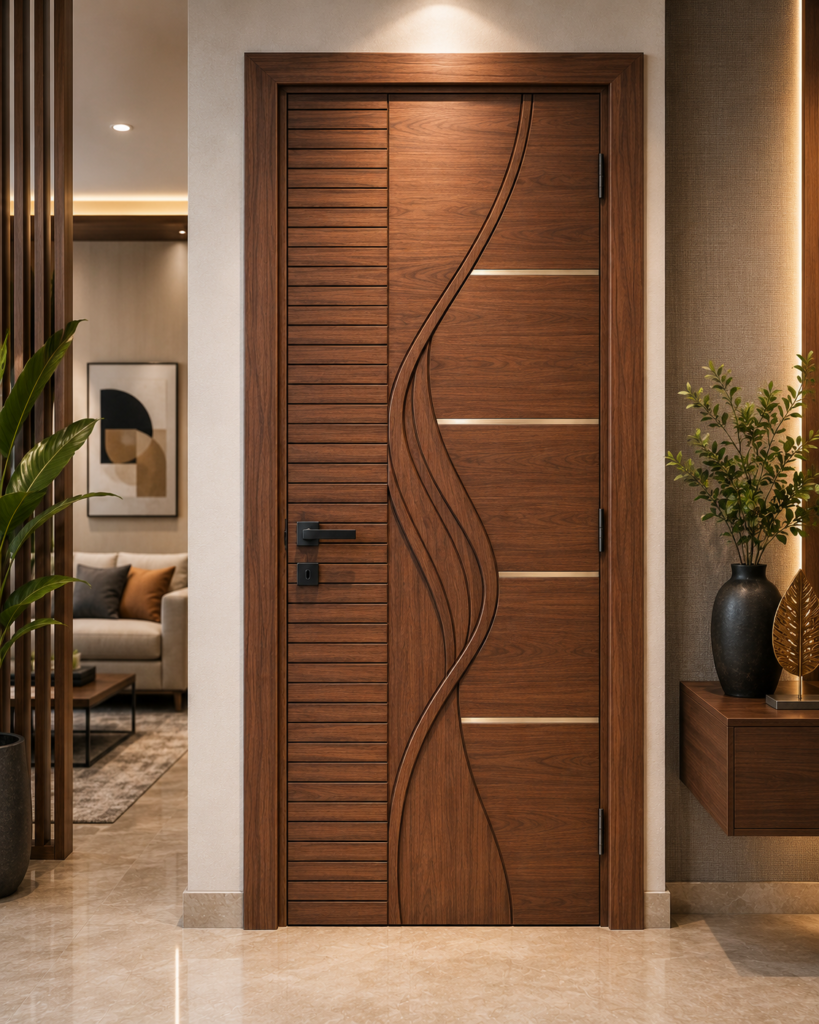
Floral patterns remain popular because they can add character to a wooden surface while maintaining a handcrafted appearance.
A CNC router can reproduce detailed floral patterns with consistent positioning.
The final appearance depends heavily on the finish. A natural wood finish can highlight the carved areas differently from an opaque painted finish.
5. Traditional Indian CNC Door Pattern
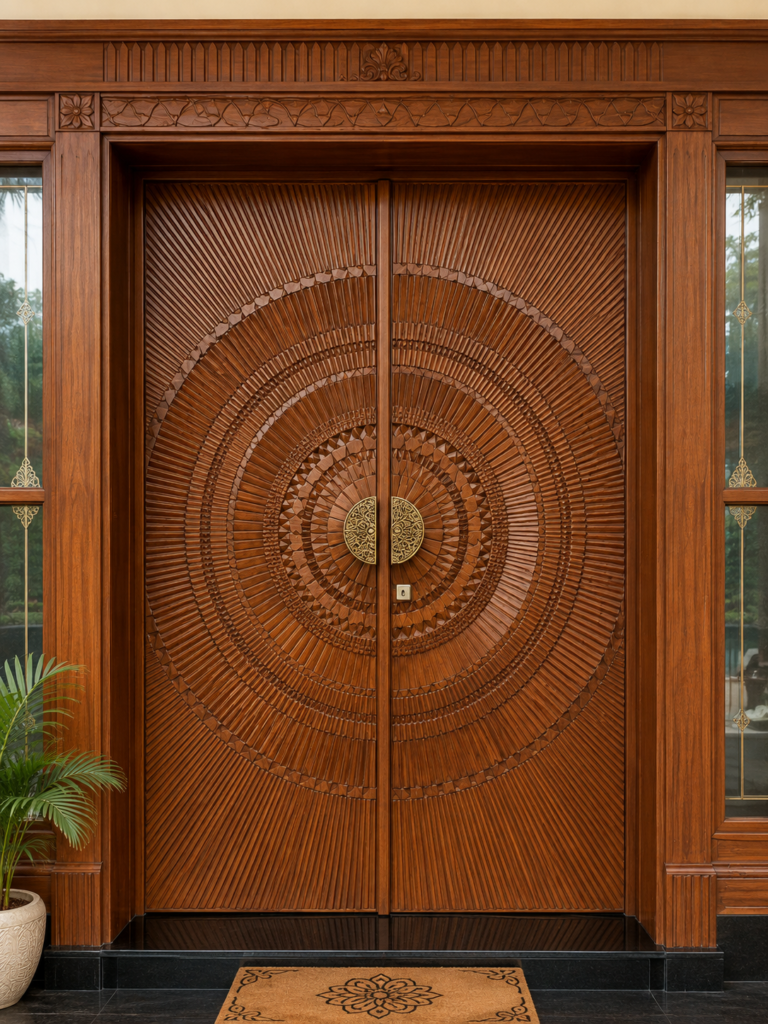
Traditional motifs can be combined with CNC technology to create a door that feels decorative without requiring entirely manual carving.
Common concepts include:
- Symmetrical floral arrangements
- Mandala-inspired geometry
- Arch patterns
- Traditional borders
- Repeating ornamental motifs
These designs can be adapted to suit modern door proportions.
6. Abstract CNC Door Design
Abstract designs are useful when the customer wants something less traditional.
Irregular lines, flowing curves, asymmetric shapes, and layered patterns can create a contemporary appearance.
The main design consideration is balance. An abstract pattern should have enough visual structure to look intentional after cutting.
7. CNC Panel Door Design
Instead of covering the complete door with a pattern, CNC cutting can be concentrated within selected panels.
This gives the door a combination of plain and decorative surfaces.
For example, a door can have:
- Plain outer borders
- A central CNC pattern
- Decorative upper panel
- Simple lower section
This approach often works well when the door needs a premium but restrained appearance.
8. Custom Name or Symbol Design
For certain interior applications, customers may want a personalized symbol, family name, room identifier, or business-related element incorporated into the design.
The artwork should be converted into a suitable vector format and checked before cutting.
Small details should be tested carefully because very fine elements may not reproduce properly depending on the material and cutter size.
Popular Wooden Door Design Styles
A CNC machine provides the cutting capability, but the design style determines the character of the final door.
| Door Style | Visual Character | Suitable Interior |
|---|---|---|
| Geometric | Clean and structured | Modern |
| Floral | Decorative and warm | Traditional/Contemporary |
| Jali | Detailed and ornamental | Indian/Modern |
| Minimal Groove | Simple and elegant | Minimalist |
| Abstract | Artistic and contemporary | Modern |
| Panel CNC | Balanced and premium | Residential |
| Traditional Motif | Cultural and decorative | Classic/Indian |
When selecting a wooden door design, consider the room, wall colour, furniture, lighting, and overall interior theme rather than choosing the pattern separately.
Best Materials for CNC Door Cutting
The material should be selected before finalizing the design because different materials behave differently during CNC routing.
Solid Wood
Solid wood can produce an attractive natural finish and is suitable for premium wooden doors.
However, natural wood has grain direction and can behave differently during machining. Moisture and wood movement also need to be considered during fabrication and installation.
Plywood
Good-quality plywood can be used for various CNC applications where dimensional stability and layered construction are suitable for the project.
The quality of the plywood matters. Poor-quality sheets can produce uneven edges or visible layer problems after cutting.
MDF
MDF is widely used for decorative interior work because it provides a relatively uniform surface for routing and painting.
It can be suitable for decorative door panels and interior applications where the material is appropriately specified and protected from moisture.
PVC / Other Interior Panels
Certain PVC-based sheets and interior boards can also be CNC routed, depending on their composition and manufacturer recommendations.
The cutting method should be selected according to the material rather than applying the same settings to every sheet.
CNC Door Design Material Comparison
| Material | Main Advantage | Key Consideration | Typical Use |
| Solid Wood | Natural appearance | Grain and moisture movement | Premium wooden doors |
| Plywood | Layered construction and versatility | Sheet quality | Interior doors/panels |
| MDF | Uniform routing surface | Moisture sensitivity | Painted decorative doors |
| PVC Board | Lightweight options | Material-specific cutting | Interior decorative work |
There is no single “best” material for every door. The correct choice depends on location, finish, budget, structural requirements, and expected usage.
How CNC Door Cutting Works
Professional CNC door cutting normally starts well before the material reaches the machine.
Step 1: Design Preparation
The required pattern is created or modified in suitable CAD/CAM software.
Step 2: Size and Scale Check
The design is checked against the actual door dimensions.
This step prevents problems such as:
- Incorrect proportions
- Pattern extending into hardware areas
- Uneven borders
- Misaligned central motifs
Step 3: Toolpath Generation
The design is converted into machine instructions. Cutting depth, tool movement, passes, and other machining parameters are considered.
Step 4: Material Setup
The sheet or door panel is placed securely on the CNC bed.
Proper workholding is essential. Movement during cutting can affect dimensions and surface quality.
Step 5: CNC Cutting
The router follows the programmed toolpath to cut or carve the design.
Step 6: Inspection
The finished panel should be checked for:
- Dimensions
- Edge quality
- Pattern accuracy
- Cut depth
- Surface damage
- Unwanted tool marks
Step 7: Finishing
Depending on the material, the door may be sanded, painted, laminated, polished, stained, or otherwise finished.
Step 8: Installation
Final fitting and hardware installation should be performed carefully so that the decorative CNC pattern is not damaged.
How to Choose the Right CNC Door Design
Choosing a design only because it looks attractive online can create problems later.
Use these practical checks before finalizing your pattern.
Consider Door Size
A pattern designed for a large door may look crowded on a smaller door.
The design should be scaled according to the actual dimensions.
Consider the Interior
Look at the furniture, wall treatment, flooring, ceiling, and lighting.
A highly decorative door can compete with an already detailed interior.
Check Pattern Density
Dense designs contain many cutouts or narrow elements.
For frequently used doors, a balanced pattern with adequate material around the cut areas is often more practical.
Plan for Door Hardware
Handles, hinges, locks, closers, and other hardware require clear areas.
The CNC design should not interfere with these components.
Think About Finishing
Ask how the finished door will look after painting, staining, laminating, or polishing.
A pattern that looks excellent on an unfinished panel may appear very different after finishing.
What Affects CNC Door Cutting Cost?
There is no universal price for CNC door cutting. The final cost can vary according to several project-specific factors.
Material
Solid wood, plywood, MDF, and other materials have different costs and machining requirements.
Design Complexity
A simple groove pattern generally requires less machining than a highly detailed decorative pattern.
Cutting Depth
Deep routing may require additional machining passes.
Door Size
Larger panels require more material and may require more machine time.
Design Preparation
A customer-supplied production-ready vector file may require less preparation than a design that needs significant modification.
Finishing
Painting, polishing, staining, edge treatment, and other finishing work can add to the overall project cost.
Quantity
Multiple identical doors may allow the same CNC program to be reused, although setup, material, finishing, and inspection requirements still apply.
The best way to compare quotes is to provide the same dimensions, material specification, design, finish, and quantity to each service provider.
Professional Quality Checkpoints
Before accepting a CNC-cut door, check more than the pattern itself.
Design Accuracy
Compare the finished door with the approved drawing.
Border Consistency
Look at the distance between the decorative pattern and the door edges.
Cut Quality
The routed areas should be checked for unwanted burn marks, tearing, excessive fuzzing, or rough edges.
Structural Areas
Make sure the remaining material around the pattern is appropriate for the intended application.
Surface Quality
The panel should be inspected before finishing because sanding and paint cannot always hide poor machining.
Hardware Compatibility
Confirm that the CNC design leaves suitable areas for hinges, locks, handles, and other fittings.
These checks are simple, but they can prevent expensive rework.
Common CNC Door Design Mistakes
1. Choosing a Pattern Without Checking Door Dimensions
A design can look perfect in a sample image but become disproportionate when scaled.
Better approach: Finalize the pattern after confirming actual door dimensions.
2. Making the Design Too Dense
Too many small cutouts can make cleaning and finishing more difficult and may reduce the practical strength of the panel.
Better approach: Maintain sensible spacing and material bridges.
3. Ignoring Material Properties
A design suitable for MDF should not automatically be treated as suitable for every type of wood.
Better approach: Select the material and machining strategy together.
4. Forgetting Hardware Locations
Decorative patterns should not interfere with hinges or locks.
Better approach: Mark hardware zones before final toolpath preparation.
5. Comparing Only the Lowest Price
A lower quote may exclude finishing, design preparation, material, edge treatment, or installation.
Better approach: Compare the complete scope of work.
6. Skipping a Design Proof
A spelling error, wrong scale, or incorrect pattern orientation can become expensive once cutting starts.
Better approach: Approve the final drawing before production.
Expert Tips for Better CNC Door Results
Tip 1: Use a design with enough negative space. It makes the pattern easier to see and can simplify finishing.
Tip 2: Keep the door’s functional areas separate from decorative areas.
Tip 3: Ask for a preview of the final scaled design before cutting.
Tip 4: Confirm the material thickness before toolpath preparation.
Tip 5: For detailed designs, consider a small test cut when the material or finish is unfamiliar.
Tip 6: Do not judge machining quality only from photographs. Inspect the actual cut surface whenever possible.
Tip 7: Think about cleaning. Very deep or narrow decorative recesses can collect dust over time.
Tip 8: Coordinate the door design with nearby wall panels, wardrobes, partitions, and furniture for a more cohesive interior.
Maintenance Tips for CNC Wooden Doors
A CNC-cut wooden door can remain attractive for years when the material and finish are properly maintained.
- Dust the surface regularly using a soft, dry cloth.
- Clean decorative grooves gently so dust does not accumulate.
- Avoid excessive water on MDF or other moisture-sensitive materials.
- Use cleaning products compatible with the door’s finish.
- Inspect edges and corners periodically.
- Check hinges and handles if the door begins to sag or rub.
- Repair damaged finishes promptly, especially in areas exposed to moisture.
- Avoid harsh abrasive cleaning methods that can damage painted or polished surfaces.
For exterior applications, the finish and material specification need additional consideration because sunlight, rain, humidity, and temperature changes can affect performance.
Where Can CNC Door Designs Be Used?
CNC door designs are not limited to residential entrance doors.
They can also be used for:
- Bedroom doors
- Living room doors
- Pooja room doors
- Office doors
- Hotel interiors
- Restaurant interiors
- Wardrobe shutters
- Decorative partitions
- Cabinet fronts
- Wall panels
- Reception areas
- Commercial interiors
A similar CNC pattern can also be adapted for matching wall panels, partitions, furniture elements, or decorative screens.
These related pages are already present in the Sourav CNC Works site structure, making them useful contextual internal-link targets.
Frequently Asked Questions
1. What is CNC door design?
CNC door design is a digitally prepared decorative pattern that is cut, carved, or engraved on a door panel using a computer-controlled CNC router.
2. Which material is best for CNC door cutting?
There is no single best material for every application. Solid wood, plywood, MDF, and other suitable boards can be used depending on the door’s location, design, finish, moisture exposure, and structural requirements.
3. Is CNC cutting suitable for wooden doors?
Yes. CNC routing is widely suited to decorative wooden door work when the material, cutter, design, and machining parameters are selected correctly.
4. Can I create a custom CNC door design?
Yes. A custom design can be prepared according to the required door dimensions and preferred pattern. The artwork should be checked for machining feasibility before production.
5. Are CNC jali designs suitable for doors?
CNC jali patterns can be suitable for decorative doors and panels. However, the pattern needs adequate material bridges and structural consideration so the finished panel remains practical for its intended use.
6. How much does CNC door cutting cost?
The cost depends on material, door size, design complexity, cutting depth, quantity, design preparation, finishing, and other project requirements. A final quote should be based on the complete scope rather than the pattern alone.
7. Can MDF be used for CNC door designs?
MDF can be used for many interior decorative CNC applications because its relatively uniform structure is suitable for routing. Its moisture limitations and intended application should be considered.
8. Can a CNC door design be painted?
Yes. Many CNC-cut MDF and wooden designs can be finished with suitable paints, stains, polishes, or other coatings depending on the material.
9. How do I choose a modern CNC door design?
Start with the door dimensions, interior style, material, finish, hardware locations, and required level of decoration. A pattern should look good at the actual door scale, not only in a design preview.
10. Where can I get customized CNC door cutting?
You can discuss your required dimensions, material, pattern, quantity, and finish with a professional CNC cutting service such as Sourav CNC Works to determine the appropriate production approach.
Conclusion
A well-designed CNC door can add a strong visual element to a modern interior without making the space feel over-decorated.
The key is to look beyond the pattern itself. CNC door design should be selected together with the material, door dimensions, hardware positions, cutting depth, finishing method, and intended use.
Geometric patterns work well for contemporary interiors, while floral and jali patterns can bring a more decorative or traditional character. Minimal grooves are useful when the goal is a clean and understated appearance.
For professional CNC door cutting, accurate design preparation and material selection are just as important as the CNC machine itself. A quality result comes from the complete process—from the approved drawing and material setup to machining, inspection, finishing, and installation.
Sourav CNC Works provides CNC-based cutting and decorative design solutions for interior and architectural applications. If you have a door drawing, reference image, or custom pattern in mind, share the required dimensions and material details so the design can be evaluated for practical CNC production.
Get Your Custom CNC Door Design
Looking for a modern CNC door design, wooden door design, or customized CNC door cutting for your interior project?
Contact Sourav CNC Works with your door size, preferred material, design reference, quantity, and finishing requirement.
Choose the design carefully. Cut it accurately. Finish it properly.